HDMI sound via ATI graphics card: Difference between revisions
From WickyWiki
No edit summary |
mNo edit summary |
||
| (13 intermediate revisions by 2 users not shown) | |||
| Line 3: | Line 3: | ||
[[Category:201307]] | [[Category:201307]] | ||
This concerns the AMD proprietary driver (fglrx) | |||
The | == ATI graphics HDMI sound disabled when the television turned off == | ||
The ATI graphics card HDMI sound device is disabled when the television is turned off. Bug report: | |||
* https://bugs.launchpad.net/ubuntu/+source/fglrx-installer/+bug/1001842 | |||
Workaround 1: | |||
# Turn TV on | # Turn TV on | ||
# Reboot | # Reboot | ||
# Keep it on | |||
Open ''sound settings'': | Workaround 2: | ||
# Go to terminal CTRL+ALT+F1 | |||
# Back to Unity CTRL+ALT+F7 / 8 | |||
Workaround 3: | |||
<syntaxhighlight lang=bash> | |||
xrandr -display :0 --output DFP2 --off | |||
xrandr -display :0 --output DFP2 --auto | |||
</syntaxhighlight> | |||
Open ''sound settings'', you should see an HDMI Audio device here: | |||
<blockquote> | <blockquote> | ||
[[File:SoundSettings.png|600px|link=]] | [[File:SoundSettings.png|600px|link=]] | ||
</blockquote> | </blockquote> | ||
== Testing HDMI audio device == | |||
First find your HDMI sound device, in this case '''card 1''', '''device 3''': | First find your HDMI sound device, in this case '''card 1''', '''device 3''': | ||
| Line 32: | Line 52: | ||
</blockquote> | </blockquote> | ||
The following file loads the devices: | |||
<blockquote> | <blockquote> | ||
/etc/pulse/default.pa | |||
. | |||
</blockquote> | </blockquote> | ||
Test with ''aplay'' or with ''speaker-test'' (card 1, device 3): | Test with ''aplay'' or with ''speaker-test'' (card 1, device 3): | ||
Latest revision as of 15:57, 15 July 2013
This concerns the AMD proprietary driver (fglrx)
ATI graphics HDMI sound disabled when the television turned off
The ATI graphics card HDMI sound device is disabled when the television is turned off. Bug report:
Workaround 1:
- Turn TV on
- Reboot
- Keep it on
Workaround 2:
- Go to terminal CTRL+ALT+F1
- Back to Unity CTRL+ALT+F7 / 8
Workaround 3:
xrandr -display :0 --output DFP2 --off
xrandr -display :0 --output DFP2 --auto
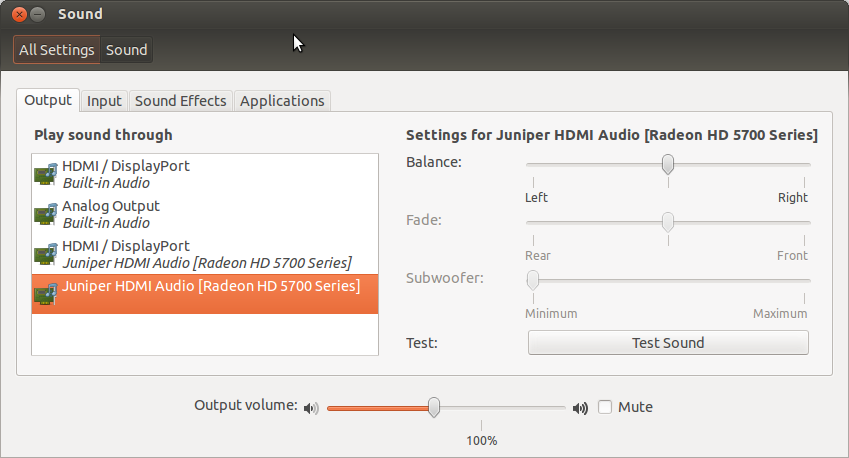
Open sound settings, you should see an HDMI Audio device here:
Testing HDMI audio device
First find your HDMI sound device, in this case card 1, device 3:
aplay -l
**** List of PLAYBACK Hardware Devices ****
...
card 1: Generic [HD-Audio Generic], device 3: HDMI 0 [HDMI 0]
  Subdevices: 1/1
  Subdevice #0: subdevice #0
The following file loads the devices:
/etc/pulse/default.pa
Test with aplay or with speaker-test (card 1, device 3):
aplay -D plughw:1,3 ~/Scripts/other/alarm.wav
speaker-test -c 2 -r 48000 -D hw:1,3
Make sure the card is not muted:
sudo apt-get install gnome-alsamixer
alsamixer
- F6 to select the device
- M to mute/unmute
